


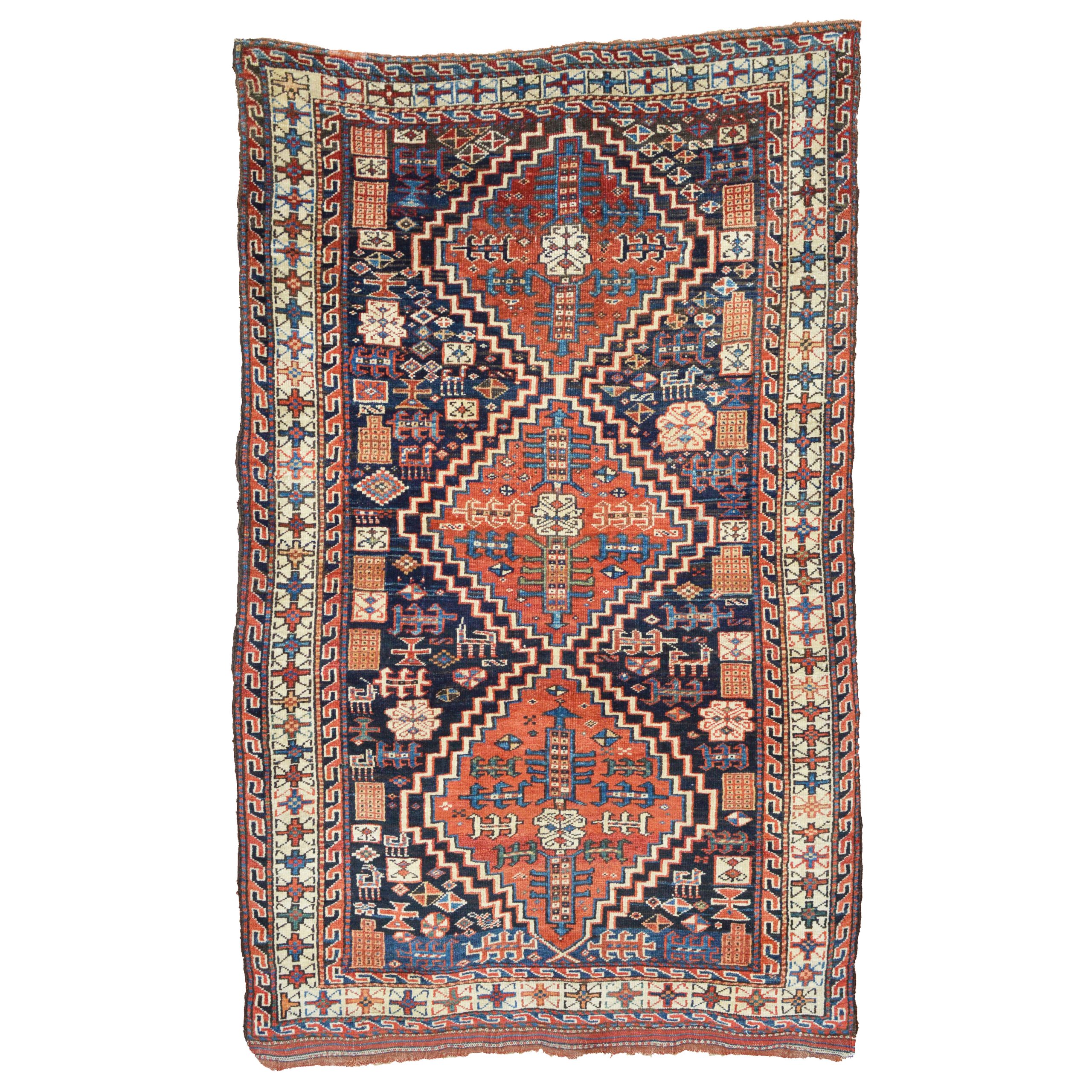
4’5″ x 6’10” Antique Northwest Persian (?) Tribal Rug, Probably A Nomadic Rather Than Village Weaving, Circa 1900
For price or additional information, please call Helen or Douglas at (781) 205-9817 or send us an e-mail via the Contact page.
While Helen and I have a pretty strong knowledge of antique Persian village rugs, I admit to knowing less about tribal rugs that are probably of nomadic origin. I find this piece puzzling and would welcome the insights of others.
One colleague suggested it could be southwest Persian but I do not see it. It seems to have more northwest Persian influence, including motifs that seem to have an influence from rugs woven further north in the Caucasus.
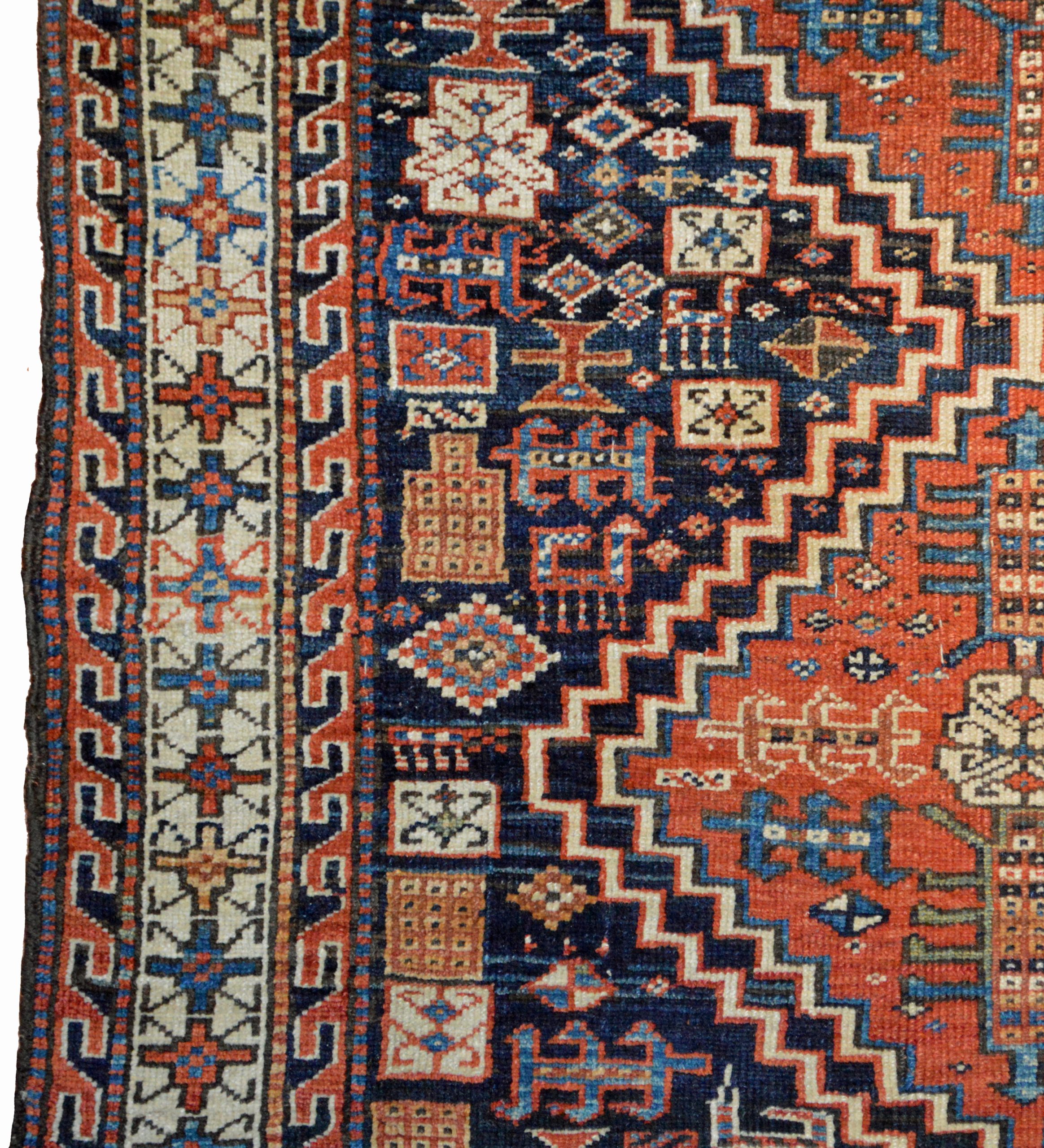
The abrashed (variegated) navy blue field is decorated with three terra cotta color medallions. The field itself has various stylized animals similar to what one might see in antique Caucasian rugs. The ivory border seems, at least to my eye, to be fairly generic. Something about the guard borders seems influenced by Souj Bulagh weavings which are generally woven by Kurdish people in Persian Azerbaijan province.
The weave is what one could call “single knotted”; i.e., in many areas both halves of an individual knot wrap around contiguous warp (vertical foundation) threads on a flat plane, rather than a stacked knot where only one line of a color is generally visible, such as what one sees in Bidjar rugs. That said, the weave is somewhat heavier than many single knotted rugs like those woven in Senneh in Kurdistan province or the various villages further south in Hamadan province.
The rug has red wefts (horizontal foundation threads) and ivory wool warps. A flat woven “kilim” end finish is largely intact at one end.
If this is a product of Kurdish weavers, I really can not say from where. It does not suggest being from the Bidjar area. I suppose it could be from the Veramin area in north central Persia, though relatively few rugs were woven in Veramin, where the majority of weaving was saddle or tent bags. It could be woven further north in Persian Azerbaijan, very close to the Caucasus, which leads to the question of whether it is Kurdish or possibly Shah Savan.
It is a very cool example of real tribal textile art and would go well in a range of interiors. Please, just do not ask us where it was woven, though we are going to try to learn from others who might have some insights.
To view detail photos, place cursor on image and use arrows.
ge.