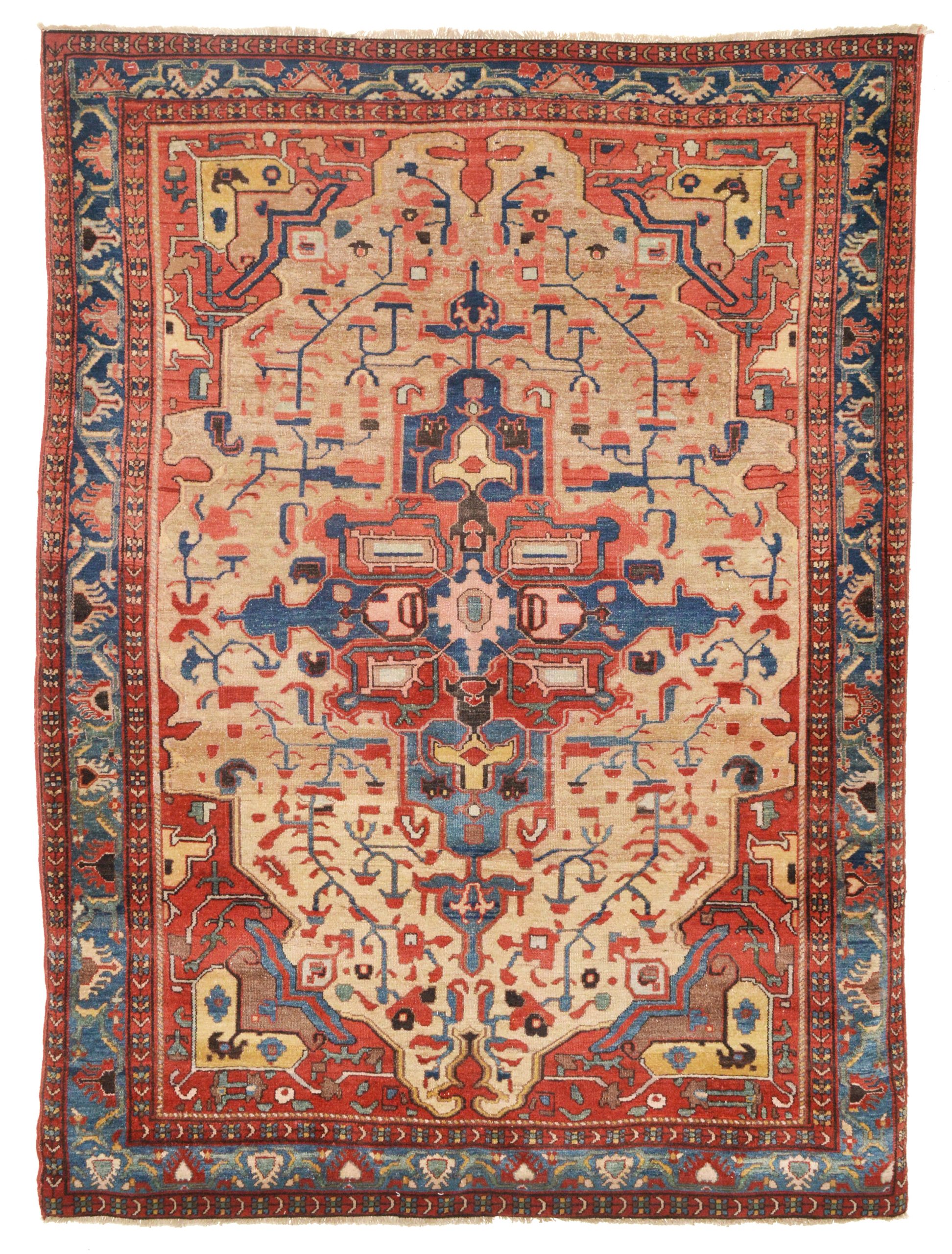
4’9″ x 6’4″ Antique Mishin Melayer Rug, Camel Field, Hamadan Province, West Persia, Circa 1895
Mishin Melayer rugs were the finest rugs woven in west Persia’s Hamadan province in the late 19th and early 20th centuries. They frequently have aesthetics similar to Fereghan Sarouk rugs from the late 19th century but have a different construction.
This rug is highly distinctive in terms of its appearance. With the single knotted construction, with both halves of an individual knot on a flat plane, unlike Fereghan Sarouk or Bidjar rugs where the two halves of an individual knot are stacked directly over and under, the rug has a light weight and thin pile. This construction somewhat resembles antique Karaja rugs, the only rugs produced in the Heriz district in northwest Persia to not have “depressed warps”; that is, the two halves of the knot stacked, in most cases in the Heriz area with the weave being an “alternate depressed warp” construction rather than truly stacked directly as one might see in a Bidjar rug.
19th century rugs woven in Karaja are often known colloquially as antique “Serapi” rugs, as are their Heriz counterparts. This Mishin Melayer rug has a design that resembles antique “Karaja Serapi” rugs, with a prominent central medallion surrounded by a field, in this case featuring a rare light camel color, that is decorated with stylized vines, leaves and flowers. The “abrashed” (variegated color) corner spandrels go from a salmon color at the top to more of a madder red at the bottom and each is decorated with a yellow heart shaped motif with stylized flowers. A deep sky blue border frames the field.
A highly distinctive rug with great decorative qualities and an excellent example of late 19th century Persian village weaving.
For price or additional information, please call Helen or Douglas at (781) 205-9817 or send us an e-mail via the Contact page.