
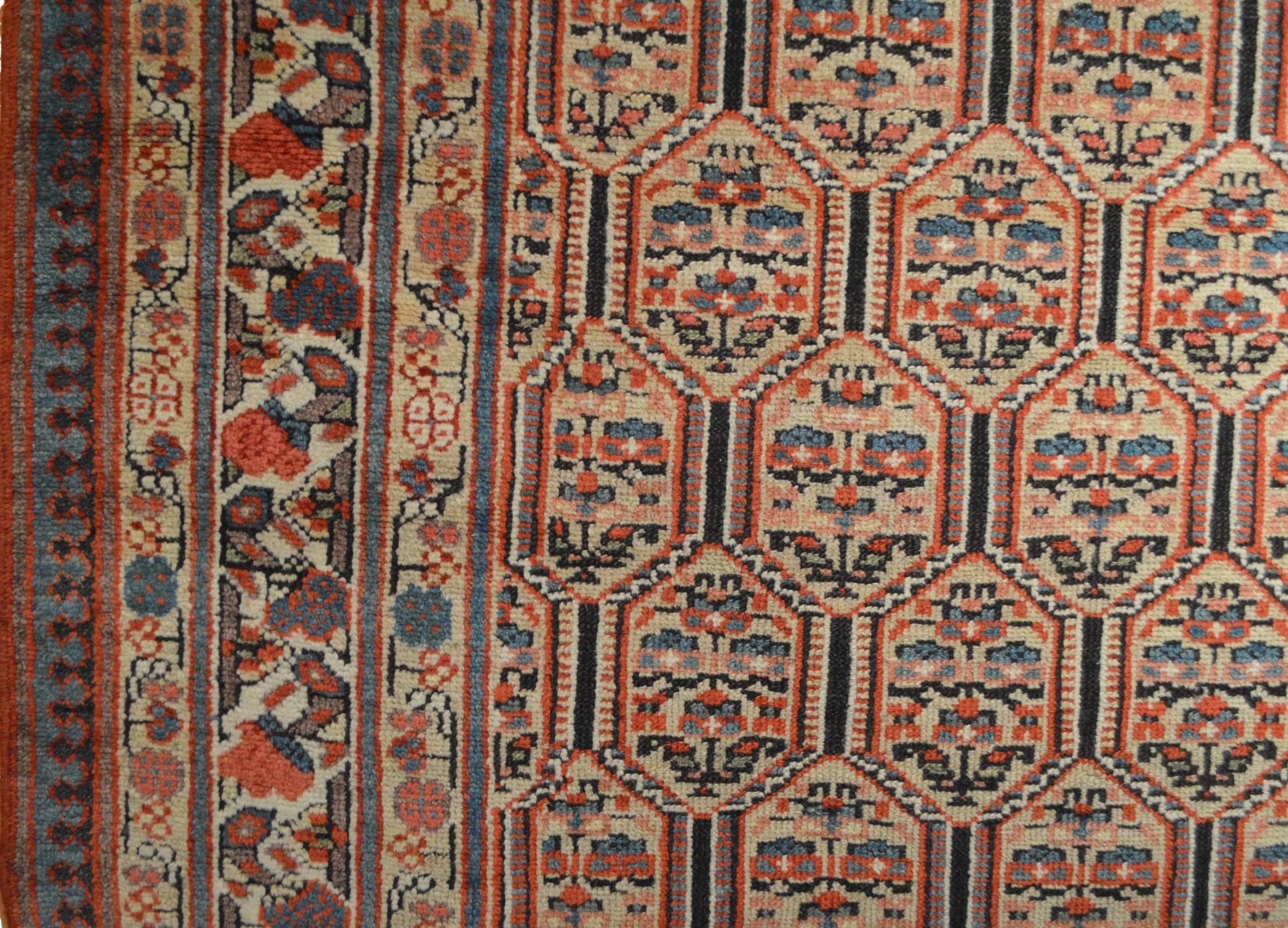

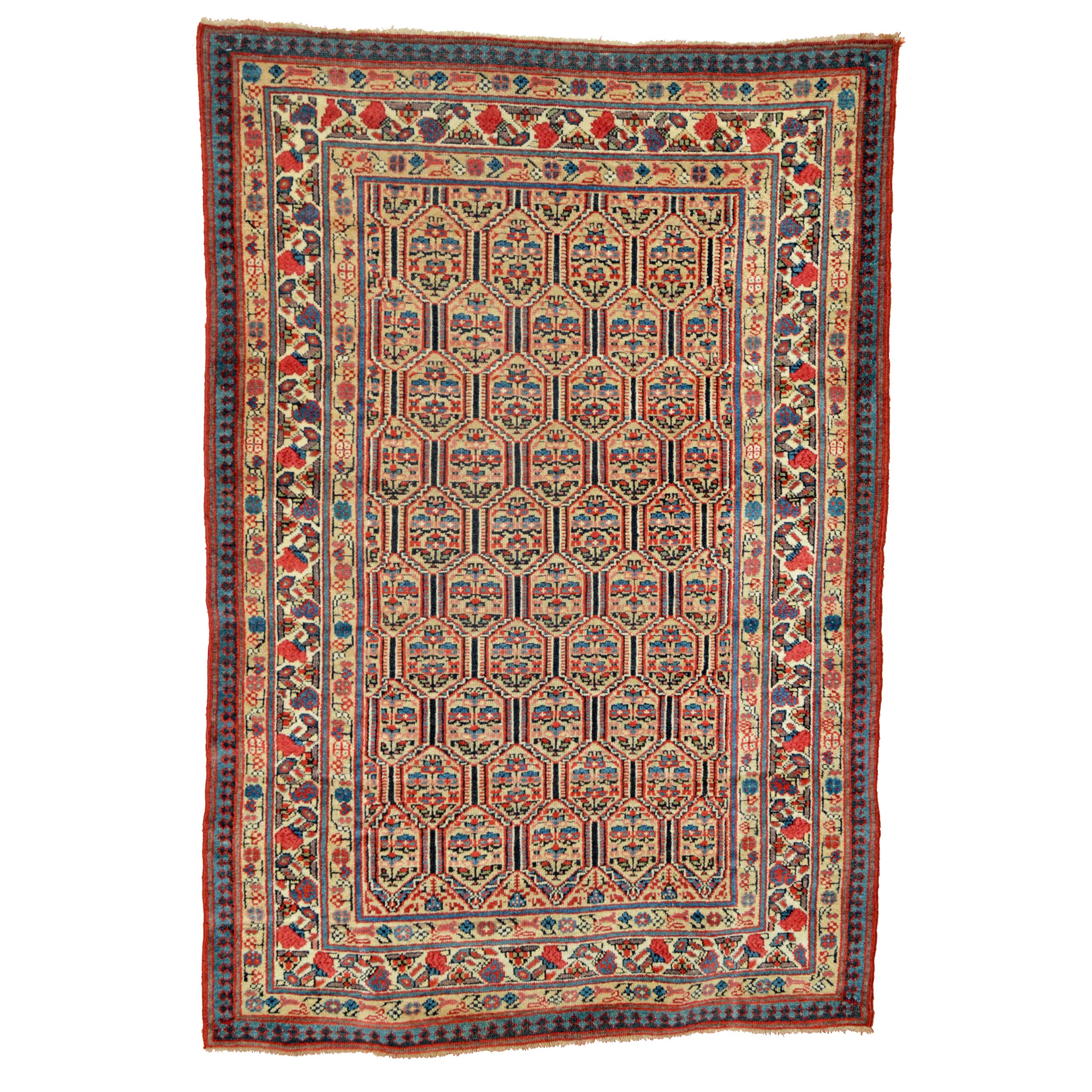
4’4″ x 6’5″ Antique Northwest Persian Rug, Lattice & Shrub Design, Azerbaijan Province, Circa 1900
For price or additional information, please call Helen or Douglas at (781) 205-9817 or send us an e-mail via the Contact page.
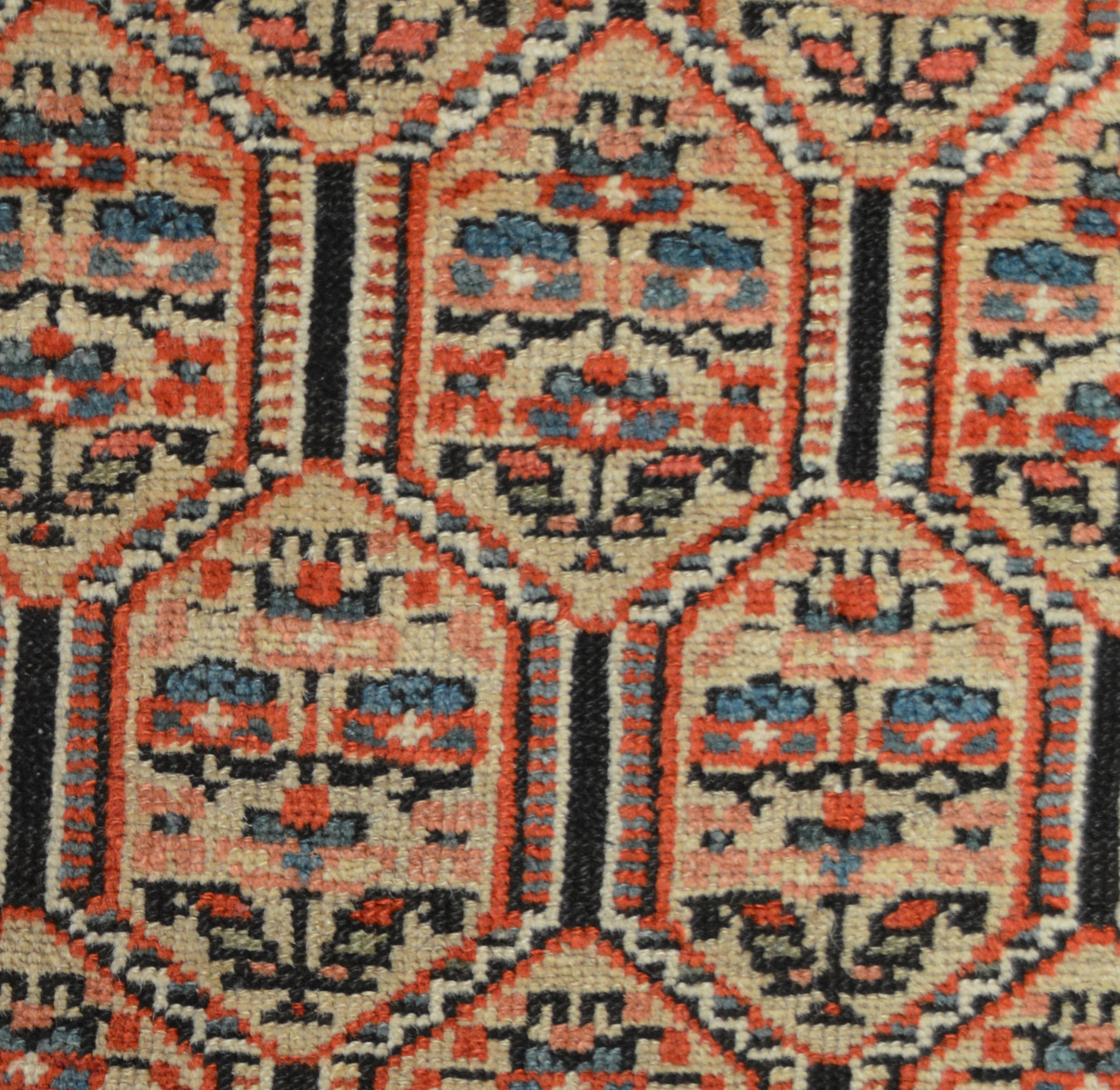
To view detail photos, including one of the weave that also shows the range of colors well, place your cursor on the image and use the arrows.
A charming antique northwest Persian rug with a camel color field that is decorated with a Lattice and Shrub design. An ivory major border with camel color guard borders and a Reciprocal Trefoil outer border frame the field.
The use of aubergine and at least two different shades of green, along with dark brown, camel, madder red, ivory, sky blue, mid blue, coral and what appears to be a very deep greenish navy blue that almost looks brown suggest the rug might be older than our conservative dating.
An interesting feature of this rug, and somewhat enigmatic, is the use of cotton for both the warps (vertical foundation threads) and wefts (horizontal foundation threads). At first glance, one might say this rug is a northwest Persian Kurdish rug, given that Kurdish weavers seem to have liked Lattice and Shrub formats and with the wide ranging palette. Helen and I almost deliberately avoid being “technicians” when it comes to rugs, as it can often obscure or distract from a focus on the aesthetics, which we largely consider to be more important. In the case of this rug, it seems worth going into some additional technical detail. First, this rug is almost certainly not from Bidjar or Senneh, each a village in Kurdistan province. Bidjars of this age are likely to have either wool warps or wefts, or both. Furthermore, Bidjar weavers employed a weave structure using multiple weft threads that were tightly packed with a metal comb and hammer. This caused one half of an individual knot to be positioned more or less directly over the other half of the knot. People sometimes call this “double wefted” but in fact Bidjars can sometimes have three or four wefts. The way I learned it more than four decades ago was to call this structure “double knotted”, where only one half of a knot can be seen on the back. The actual terms do not make much difference but in some cases the structure really does. This rug has both halves of the individual knots visible on a flat plane, or what we could call a “single knotted”, and some other people might call a “single wefted”, construction. There are single knotted Kurdish rugs made outside of Bidjar but they almost always have wool warps and/or wool wefts. Senneh rugs, also woven in Kurdistan, usually have cotton foundations, with the exception of the rare silk warp group and the occasional heavier weave Senneh rugs that might have wool foundations. However, Senneh weavers employed a distinctive twist to the knot in their rugs. This is not only visible looking at the back of a Senneh rug but one can actually feel it from the back of the rug without looking at the weave. Senneh rugs have an almost sandpaper like feel from the back and this rug does not have that character.
Moving further north into Persian Azerbaijan province, Kurdish weavers, generally in the early to late 19th century, woven rugs in the village of Souj Bulagh. Given that this rug is difficult to attribute, it is possible it was made in Souj Bulagh but rugs from there generally have a more pliable handle and thicker pile. They also tend to be more archaic. With that, we move to the Heriz district. Almost all rugs from this region are double-knotted, though the weave is typically not stacked directly with one half of a knot directly over the other but rather what is called an “alternate depressed warp”, where the individual knots are on a diagonal and hence one can see one line depressed between the adjacent lines. The only rugs from the Heriz district that vary from this formula are rugs from Karaja and the occasional Bakshaish. Almost nothing about this rug suggests it was made in Karaja. The design and colors are not typical of Karaja and nor really is the weave. That leaves the village of Bakshaish. Bakshaish rugs are famous for having a softer palette than most other rugs from the Heriz district. However, they tend to be more coarsely woven than this rug is and often use wool for either the warps or wefts. They also tend to have thicker pile and a more pliable handle, though wear over many decades can, of course, have an impact on how thick the pile of a rug is now.
I am not at all sure this rug is a Bakshaish and something suggests it is not. So, it is yet another example of what we consider a mystery rug. It is almost certainly northwest Persian, likely from Persian Azerbaijan province. It does not seem to be from the west Persian province of Hamadan or Kurdistan in northwest Persia, although much of it suggests it is a Kurdish weaving. Frankly, we do not know and welcome the insights of others.